Storage guide
How to store peptides at 2–8 °C
Research-use peptides are temperature-sensitive. This guide explains the storage temperatures in common use, how to keep a stable cold chain at home or in a clinic, and how a dedicated portable peptide fridge compares with the alternatives.
Why storage temperature matters
Peptides are short chains of amino acids, and their structure degrades when they are held warm, exposed to moisture, or cycled repeatedly between temperatures. Degradation is cumulative: every warm spell, every long door-open period and every freeze–thaw cycle removes a little more usable material. Storing at a stable, verified temperature is the single most effective control you have.
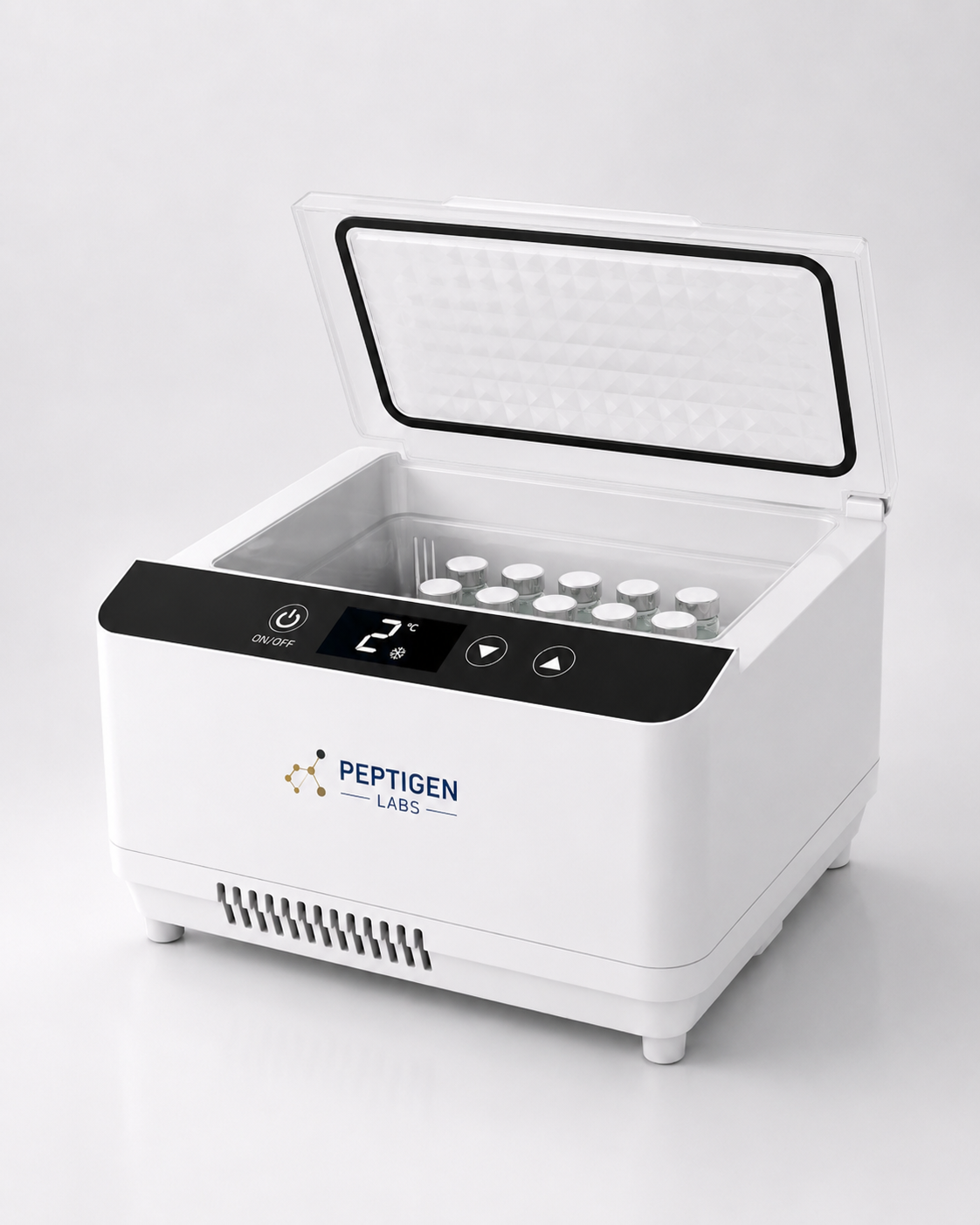
The practical goal is not simply "cold" — it is stable and visible. A unit that holds 2–8 °C and displays the live internal reading lets you confirm the cold chain at a glance rather than assume it.
Peptide storage temperature ranges
The ranges below reflect the conventions used across research-peptide suppliers. Always defer to the documentation supplied with your specific material.
| Storage state | Typical temperature | Typical use |
|---|---|---|
| Lyophilised, long-term | −20 °C or colder | Unopened stock held for months |
| Lyophilised, in use | 2–8 °C | Working stock accessed regularly |
| Reconstituted | 2–8 °C | Short working window after mixing |
| In transit | Insulated bag + gel pack | Hours, not days |
| Room temperature | 18–25 °C | Shipping only, minimise duration |
Why 2–8 °C is the working range
2–8 °C is the standard cold-chain band used for temperature-sensitive biologics. It is cold enough to slow degradation substantially, while avoiding the freeze–thaw damage that comes from moving material in and out of a freezer several times a week.
Building a reliable cold chain
A cold chain is only as strong as its weakest link. In a home-lab or clinic setting, four things carry most of the risk:
- Temperature drift — domestic fridges cycle widely and have no visible readout.
- Door openings — a shared kitchen fridge is opened dozens of times a day, warming the contents each time.
- Handling — vials left on a bench "for a moment" account for a surprising share of total warm exposure.
- Transport — moving material between sites without insulation.
Storage options compared
Four setups are commonly used. The trade-offs are stability, visibility and footprint.
| Option | Temperature stability | Live readout | Footprint |
|---|---|---|---|
| Kitchen fridge | Poor — cycles 1–9 °C | No | Shared |
| Mini bar fridge | Moderate, no fine control | Rarely | Medium |
| Cooler bag + gel packs | Hours only | No | Portable |
| Portable peptide fridge | Steady 2–8 °C | Yes — front LCD | Countertop |
| Lab refrigerator | Excellent | Yes | Large, costly |
For a fuller breakdown, see our peptide fridge vs mini fridge vs cooler bag comparison.
Storing reconstituted peptides
Once a lyophilised peptide is reconstituted, it becomes far less forgiving. Keep the vial at 2–8 °C, minimise time out of storage, avoid shaking, and keep it away from direct light. Stability windows vary widely by peptide, diluent and concentration — use the supplier's documentation rather than a general rule of thumb.
Avoid freeze–thaw cycling
Repeatedly freezing and thawing the same vial is more damaging than continuous 2–8 °C storage for most working stock. If you must freeze, aliquot first so each portion is thawed once.
Travelling with peptides
For short journeys, an insulated cooling bag with a pre-chilled gel pack keeps vials within range for several hours. Do not let vials sit directly against a frozen pack — use a cloth or divider to prevent accidental freezing. Return the material to 2–8 °C storage as soon as you arrive. Every PeptiChill order includes a travelling cooling bag for exactly this purpose; see delivery and dispatch for what ships in the box.
Common storage mistakes
- Assuming a kitchen fridge sits at 4 °C without ever measuring it.
- Storing vials in the fridge door, the warmest and most disturbed position.
- Freezing and thawing the same vial repeatedly instead of aliquoting.
- Leaving reconstituted material on the bench between uses.
- Using a glass-fronted display fridge that exposes vials to constant light.
- Transporting vials loose in a bag with no insulation.
Choosing a portable peptide fridge
Judge a unit on five things: the temperature band it actually holds, whether the live temperature is visible, noise level if it shares a room with you, internal organisation, and footprint. PeptiChill was designed against exactly that list — a steady 2–8 °C, a front-mounted digital LCD, operation under 28 dB, an internal organisation tray and a 195 × 255 × 285 mm countertop footprint. Full numbers are on the specifications table, and cover is set out under returns and warranty.
Ready to fix your cold chain?
The PeptiChill portable peptide fridge holds a steady 2–8 °C, shows the live temperature on the front panel and ships with a free travelling cooling bag.
View the Portable Peptide FridgeFrequently asked questions
- What temperature should peptides be stored at?
- Lyophilised research peptides are generally kept at 2–8 °C for everyday use, with long-term stock held frozen at −20 °C. Once reconstituted, vials are usually returned to 2–8 °C and used within a short window. Always follow the storage instructions supplied with your material.
- Can I keep peptides in a normal kitchen fridge?
- A domestic fridge cycles between roughly 1 °C and 9 °C and is opened many times a day, so the internal temperature is neither stable nor visible. A dedicated peptide fridge with a digital readout holds 2–8 °C and shows the live temperature on the front panel.
- Do peptides need to be frozen?
- Freezing at −20 °C is normally used for long-term storage of unopened lyophilised powder. For material in active use, repeated freeze–thaw cycles are the bigger risk, which is why a stable 2–8 °C working store is preferred.
- How long do reconstituted peptides last?
- Stability depends entirely on the specific peptide, the diluent and the concentration. Refer to the supplier documentation for the material you hold — PeptiChill supplies the storage environment, not stability guidance.
- Does light affect peptide storage?
- Some peptides are light-sensitive. Keeping vials inside a closed, opaque unit with a hinged lid limits light exposure and avoids the constant illumination of a glass-fronted display fridge.
- How should peptides be transported?
- Use an insulated cooling bag with a chilled gel pack for short journeys, and move the vials back into 2–8 °C storage on arrival. Every PeptiChill order includes a travelling cooling bag.
- What size cold storage do I actually need?
- Most home-lab and clinic users hold between six and thirty vials at a time. A 4 L unit with an organisation tray covers that comfortably without the footprint of a laboratory refrigerator.
- Is PeptiChill a medical device?
- No. PeptiChill is temperature-controlled storage equipment for research-use materials. It is not a medical device and is not supplied for storing medicines — see our disclaimer.
Further reading
- WHO guidance on the storage and distribution of temperature-sensitive products
- PeptiChill product disclaimer — what this equipment is and is not intended for.
- Contact the UK team with storage or specification questions.