Comparison
Peptide fridge vs mini fridge vs cooler bag
Four ways people store research-use peptides, compared on the things that actually matter: temperature stability, a visible readout, noise, footprint and cost.
Quick answer
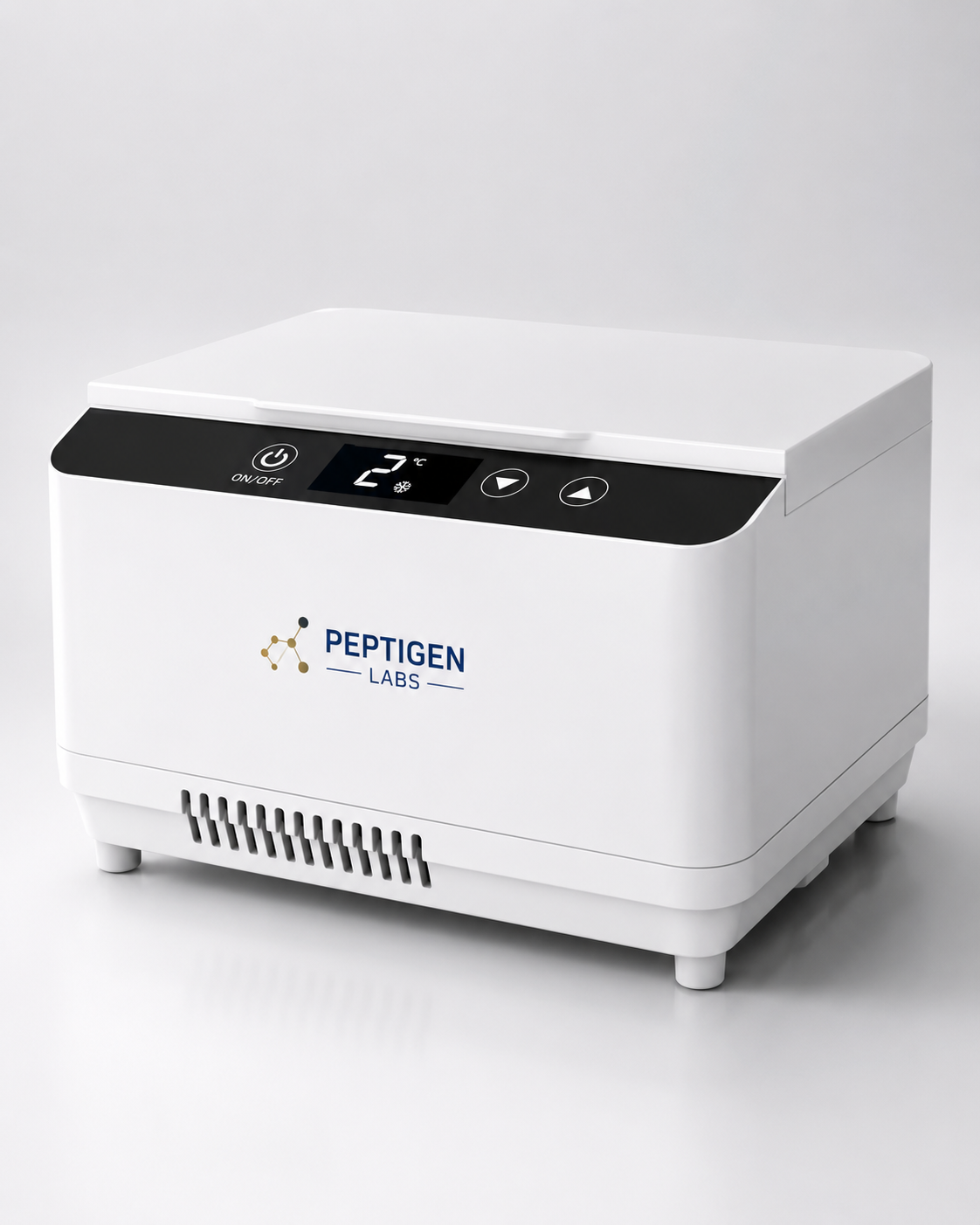
For everyday storage of research-use peptides, a portable peptide fridge is the best balance: it holds a steady 2–8 °C, shows the live internal temperature, and takes up roughly the space of a kettle. A mini fridge cools but cannot be verified, a kitchen fridge cycles too widely, a cooler bag is for transport only, and a laboratory refrigerator is overkill for a handful of vials.
Side-by-side comparison
| Peptide fridge | Mini fridge | Kitchen fridge | Cooler bag | |
|---|---|---|---|---|
| Target range | 2–8 °C | ~4–12 °C | 1–9 °C cycling | Hours only |
| Live readout | Yes, front LCD | Rarely | No | No |
| Light exposure | Opaque hinged lid | Varies | Frequent | None |
| Noise | Under 28 dB | 35–45 dB | 35–45 dB | Silent |
| Footprint | 195 × 255 × 285 mm | Medium | Shared | Portable |
| Organisation | Vial tray included | Shelves | Food shared | Loose |
| Typical cost | £89.99 | £70–£150 | Already owned | £10–£30 |
Mini fridge
Mini bar fridges are cheap and widely available, but most use a thermostat dial with no calibrated scale and no display. Internal temperature commonly drifts above 8 °C, particularly in warm rooms, and there is no way to know without adding a separate thermometer.
Best for
Drinks and non-critical items where a few degrees does not matter.
Kitchen fridge
A domestic fridge is opened many times a day and cycles across roughly 1–9 °C. The door shelves — where small items tend to end up — are the warmest and most disturbed position in the unit. It also mixes research material with food, which most users would rather avoid.
Best for
A short-term stopgap only, ideally with a fridge thermometer.
Cooler bag
An insulated bag with a chilled gel pack is the right tool for moving vials between sites, holding a usable temperature for a few hours. It is not storage: once the pack warms, temperature climbs steadily. A travelling cooling bag is included free with every PeptiChill order.
Best for
Transport, travel days and short clinic visits.
Laboratory refrigerator
Purpose-built lab refrigerators offer tight control, alarms and audit logging. They are the right answer for regulated facilities storing large volumes — and the wrong answer for someone holding a dozen vials at home, given the price and the floor space they demand.
Best for
Institutional labs with volume and compliance requirements.
Which should you choose?
If you hold research-use peptides in a home lab, clinic room or small practice, a portable peptide fridge plus an insulated bag for travel covers both storage and transport at a fraction of laboratory-refrigerator cost. Read the underlying temperature guidance in our peptide storage guide, check the full specifications, and review delivery and returns and warranty before you order. Questions? The UK team is on the contact page.
PeptiChill Portable Peptide Fridge
Steady 2–8 °C, front-mounted digital LCD, under 28 dB, 12-month warranty and a free travelling cooling bag with every order.
View the Portable Peptide FridgeFrequently asked questions
- Is a mini fridge good enough for peptide storage?
- A mini bar fridge cools, but most have a dial rather than a set temperature and no display, so you cannot confirm the internal reading. A peptide fridge holds 2–8 °C and shows the live temperature on the front panel.
- What is the difference between a peptide fridge and a lab refrigerator?
- A laboratory refrigerator offers validated performance and large capacity, at a much higher price and footprint. A portable peptide fridge targets the same 2–8 °C working band for small volumes on a countertop.
- How long does a cooler bag keep peptides cold?
- With a pre-chilled gel pack, an insulated bag typically holds a usable temperature for a few hours. It is a transport solution, not a storage solution.
- Is a peptide fridge quiet enough for a bedroom or clinic room?
- PeptiChill runs under 28 dB, which is quieter than typical background room noise and suitable for shared workspaces, consultation rooms and home offices.
- How much does a portable peptide fridge cost?
- PeptiChill is £89.99 for a single unit, with a 2-pack bundle at a 10% discount and free tracked delivery. Regional pricing is shown on the product page.
- Can I use a wine cooler instead?
- Wine coolers typically run around 8–18 °C and often have glass doors that expose contents to light, so they sit above the standard 2–8 °C cold-chain band.
- Does a peptide fridge need a dedicated socket?
- No. The unit runs from a standard mains socket and ships with a UK 3-pin plug.
- What happens if the power goes out?
- An insulated unit loses temperature slowly, but for extended outages move vials into an insulated bag with a chilled gel pack — the bag is included with every order.